Malaysian mid-sized manufacturers are running production schedules that look stable on paper and break under pressure on the floor. Especially if they are issuing job orders manually, maintaining bills of materials in version-numbered spreadsheets, and relying on supervisors to translate a customer order into a sequence of operations from experience rather than from a system. It may hold together when volumes are steady, but it imposes a hidden cost the moment a rush order arrives, a component substitution is needed, or a new SKU enters the mix. A structured production order management system solves this by binding every job to a verified bill of materials, a defined routing, and a live status that production, procurement, and quality can all see at the same time. This article explains why the gap exists in most SME factories, how Tyeda's Production Management module is built to close it, and why that matters now.
Why Disconnected Production Orders Break Schedules in Malaysian SME Factories
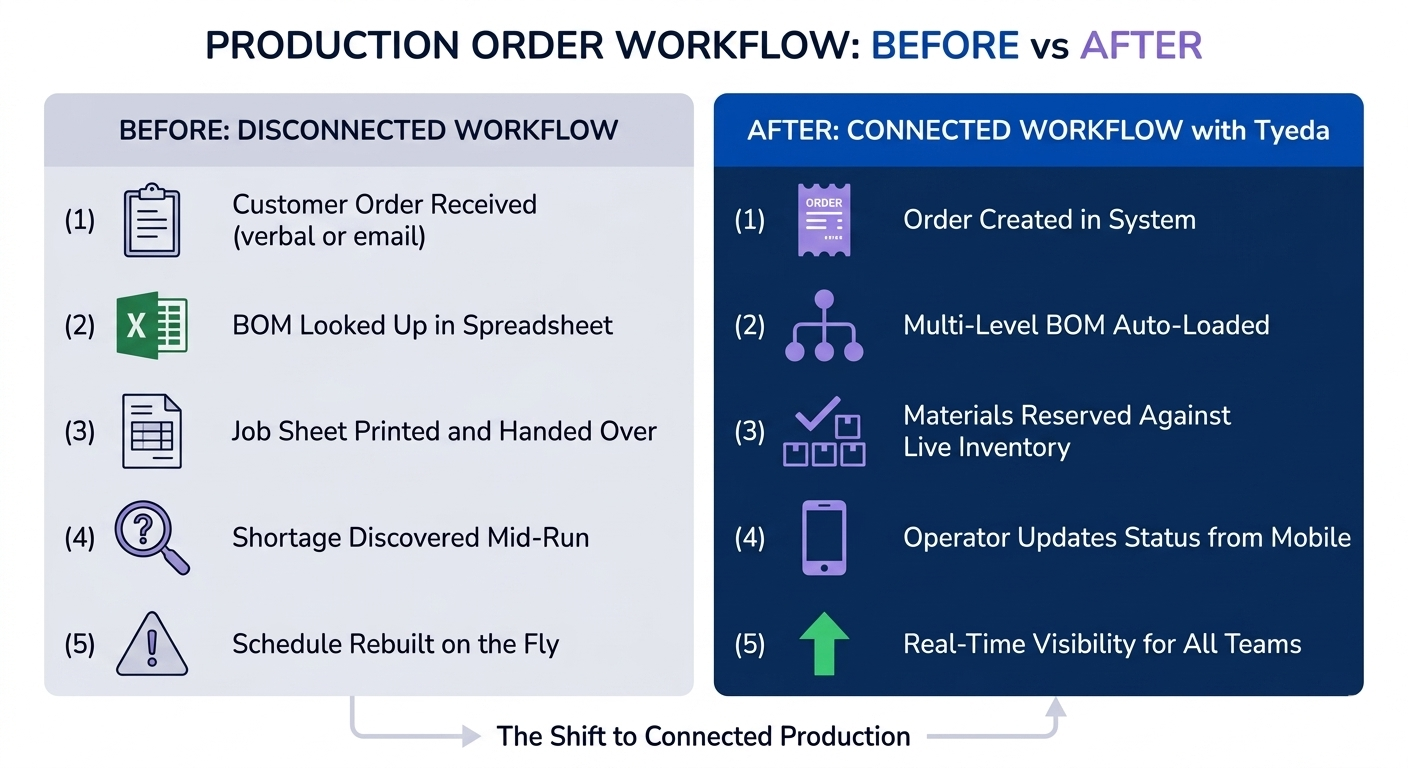
Malaysian SME manufacturers' adoption of Industry 4.0 technologies remains in what researchers describe as an early stage of development, with digital adoption across the sector estimated at around 20% and most manufacturing firms implementing less than 50% automation in their core operations (MDPI, 2022; PLOS One, 2025). The downstream effect is consistent across factory floors: a job is released to production assuming the right components are available, the supervisor discovers a shortage mid-run, and the schedule is rebuilt on the fly with whatever is in the storeroom.
The reason this happens is structural. The production order, the bill of materials and the inventory ledger exist as three separate documents maintained by three different people, and they reconcile only when someone manually checks them against each other. When a customer changes a specification or engineering revises a component, the BOM is updated in one place and the change does not propagate to the open orders that depend on it. Production runs against a stale version, defects surface at the quality stage, and the cost is absorbed silently as rework. Replacing this fragmented setup with a connected production order management system closes the loop, so every job is created from a current, version-controlled BOM and every material requirement is reserved against live inventory at the moment of release.
When Bills of Materials Live in Spreadsheets, Every Order Carries Hidden Risk
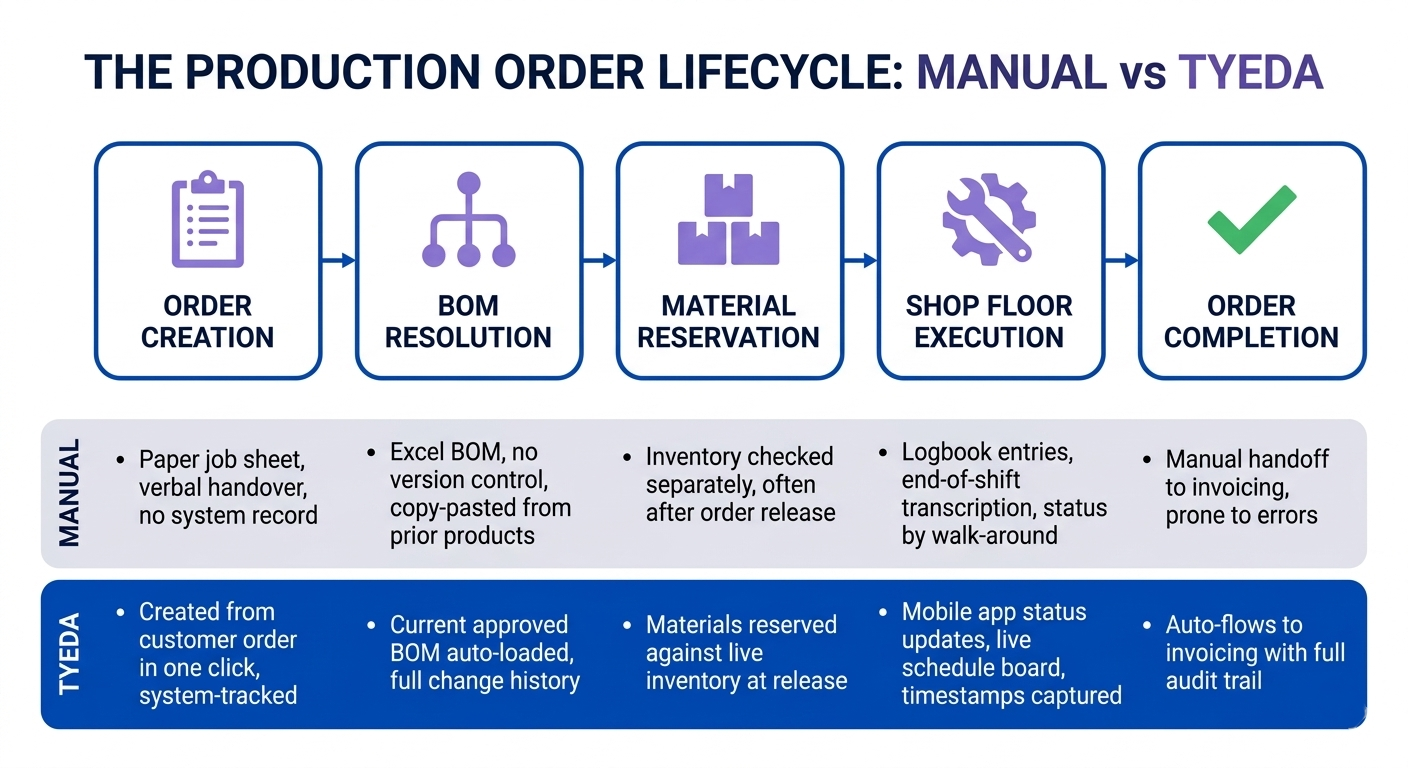
Even in factories where production orders are tracked formally, the BOM layer underneath is often the weakest link. Bills of materials sit in shared Excel files, copied and adapted from prior products, with no controlled history of what changed, when, or who approved it. The same component appears under different names across files. Sub-assemblies are flattened into parent BOMs because nesting in a spreadsheet becomes unmanageable beyond three levels.
Industry research published in 2026 estimates that BOM errors contribute to between 20% and 30% of supply chain inefficiencies in manufacturing, with the cost distributed across procurement, production and quality rather than landing on a single department's accounts (IT Supply Chain, 2026). The consequence is that costing, planning, and quality each work from a slightly different version of the truth. Without bill of materials software in a single system, there is no reliable way to answer the questions that matter on the floor: which open orders are affected if this component is recalled, what does this finished good actually cost to build today, and is the routing we are about to release the one engineering signed off on last month. The shift from spreadsheet-based BOMs to a structured, versioned BOM begins when every component, sub-assembly and operation is held in one place, change history is recorded automatically, and every production order draws from the approved revision at the time of release.
A Production Floor Running on Verbal Handovers Cannot Be Measured
The third gap is the most underestimated by factories. When job progress is communicated by walking the floor and asking the supervisor, there is no operational data being generated, only opinions about how the day went. Start times, stop times, scrap quantities, and operator assignments live in logbooks that are transcribed into spreadsheets at the end of the shift, if at all. Cycle times are estimated from memory rather than measured from completed runs.
The deeper consequence is that the factory loses the ability to improve. McKinsey research has reported that manufacturers implementing advanced analytics and real-time data capture achieve productivity gains of 10% to 25% across their operations, with the largest gains in factories that previously operated on end-of-shift reporting (McKinsey, 2021–2022, as reported by industry analyses). A connected production order system closes this gap by recording every status change, every labour entry, and every material consumption against the order as it happens, so the data needed to improve is generated as a byproduct of running the floor rather than as a separate reporting task.
How Tyeda's Production Order Management System Addresses Each of These Gaps
Tyeda's production module ties the order, the BOM, the routing, and the live floor status into one connected workflow, replacing the chain of printed job sheets, version-numbered spreadsheets, and end-of-shift logbooks that currently sit between a customer order and a completed run.
When a production order is created, it is built from the current approved BOM, with materials reserved against live inventory at the point of release. Multi-level BOMs are supported natively, so sub-assemblies, components, and operations are held in one structured tree rather than flattened into a parent spreadsheet. Change history is recorded automatically, so when engineering revises a component, the impact on open orders is visible immediately rather than discovered at the quality stage.
On the floor, operators update status from the mobile app: start operation, log labour, record scrap, complete. Each entry timestamps automatically and updates the order, inventory, and work-in-progress views in real time. Supervisors see the schedule board without walking the floor. Customer-facing teams see committed delivery dates without asking production. When an order completes, it flows directly into invoicing, so the same data that ran the floor closes the commercial loop.
Data from existing BOM spreadsheets can be imported via CSV, so years of product structure carry over and the transition does not require rebuilding from scratch. A factory can be live on basic production order creation and BOM management within the first two weeks of onboarding, with multi-level BOM and routing rolling out as your operations require them.
Why Connected Production Management Matters More Than Ever for Malaysian Manufacturers
The Ministry of Investment, Trade and Industry has set a target of 3,000 smart factories in Malaysia by 2030 under the New Industrial Master Plan 2030, with the Industry4WRD Intervention Fund directing financing toward SMEs that demonstrate measurable progress in operational digitalisation (MIDA, 2023; Bernama, 2025). At the same time, multinational buyers sourcing from Southeast Asia are increasingly requiring traceability from raw material to finished good as a condition of supply rather than treating it as internal information. Manufacturers building connected production order and BOM systems now will be positioning their operations for the contracts that depend on it.
Tyeda is a manufacturing operations platform built for Malaysian mid-sized manufacturers, bringing production, procurement, quality and compliance into one unified real-time system that holds schedules together and protects committed delivery dates. We are currently onboarding a limited number of manufacturers ahead of our full platform launch. Join the waiting list at landing.tyeda-technologies.com.
For more on how connected procurement and inventory support production outcomes, read: How Malaysian Mid-Sized Manufacturers Can Build a Procurement System That Secures Timely Production and How Malaysian Manufacturers Can Eliminate Inventory Mismatch with Real-Time Inventory Tracking.