
For Malaysian manufacturers competing in electronics, automotive, food processing and medical devices, quality management is not a periodic exercise. It is the operational foundation that determines whether products leave the floor to the right standard in every shift, every day, without exception.
The numbers reflect this. According to ISO Certified Companies in Malaysia: 2024 Industry Insights (NAK Training, 2024), Malaysia recorded 12,931 valid ISO 9001 certificates, with manufacturing representing almost 70% of all certifications in the country as of December 2024. It is a market signal telling mid-sized manufacturers where the competitive baseline is moving and what customers, supply chain partners and regulators increasingly expect.
Quality management in Malaysian SME factories most commonly breaks down at the shift handover, when inspection criteria exist in one person's interpretation rather than a standardised system. A structured quality management system (QMS) gives manufacturers the framework to meet that baseline consistently, offering traceable inspection records, standardised controls at every production stage and audit readiness that exists as a natural outcome of how the factory operates.
Structured Digital Checklists Give Every Shift the Same Quality Standard
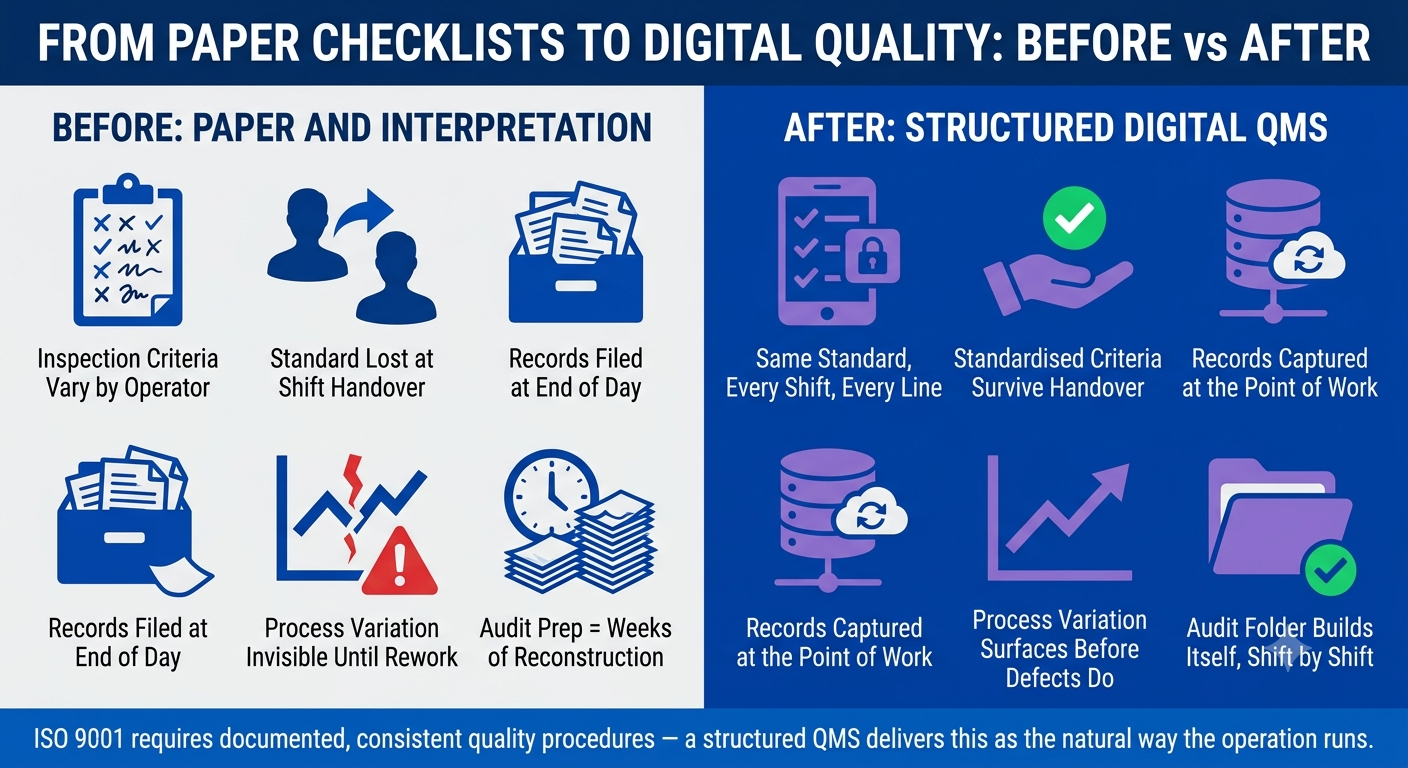
The most immediate impact of a structured QMS in SMEs is what it does to daily inspection consistency. When quality checklists are standardised and digital, every shift starts from the same point. What an operator captures on the morning shift is directly comparable to what the afternoon shift captures. Here is what that consistency looks like in practice across a mid-sized Malaysian factory:
- the same inspection criteria are applied at every checkpoint, regardless of shift or operator;
- standardised documentation formats are adopted across all production lines;
- completed entries are recorded at the point of work, in real time;
- quality records are automatically stored and immediately traceable;
- process variation surfacing in the data before it reaches the finished product.
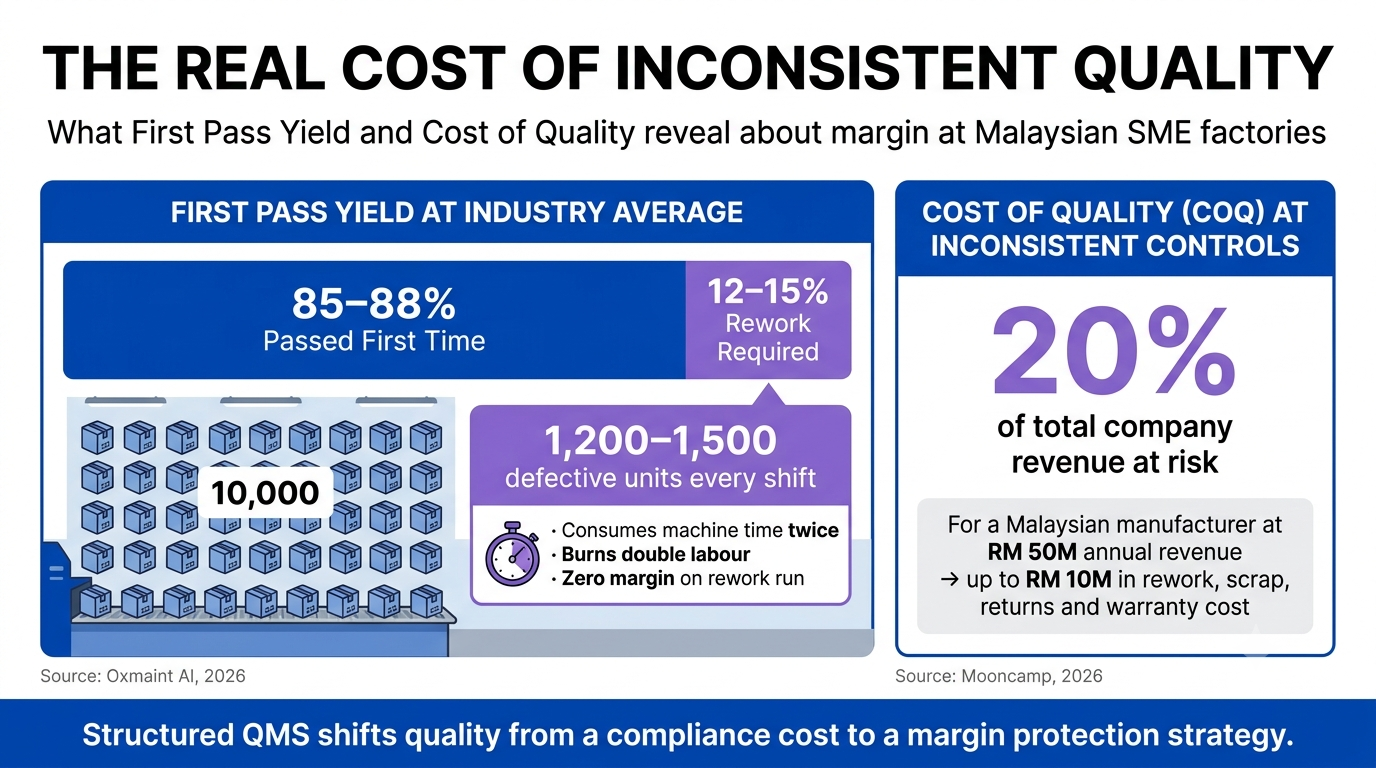
This matters because the consequences of inconsistent quality accumulate quickly. At the industry average First Pass Yield (FPY) of 85 to 88%, a factory running 10,000 units daily is producing between 1,200 and 1,500 defective units every shift, according to First Pass Yield Improvement: Manufacturing Strategies (Oxmaint AI, 2026). These very units consume machine time twice and burn double labour time while delivering zero margin on the rework run. It is a direct measure of how much of the factory's capacity is being used productively and how much is being spent recovering from variation that a structured inspection system would have caught earlier.
Digital quality checklists tied to each production stage, completed in real time by operators at the point of work, give quality teams the live visibility to see where variation is occurring and address it before it compounds across a full production run, enabling a more efficient FPY and, in turn, better margin.
Why Quality Varies Between Shifts and How Standardised Controls Fix It
Standardisation is where quality management moves from a checklist exercise to a system. When quality controls are standardised across every production line and every shift, the outcome of each product no longer depends on individual interpretation of what a passing standard looks like. The criteria are defined, documented and applied the same way every time.
The cost of poor quality can consume up to 20% of a company's total revenue when quality controls are inconsistent or reactive rather than standardised and proactive, according to an article, Cost of Quality (COQ) (Mooncamp, 2026). For a Malaysian manufacturer with RM 50 million annual revenue, that represents up to RM 10 million in rework, scrap, customer returns and related costs. This kind of number changes the conversation from quality being a compliance function to quality being a margin protection strategy.
ISO 9001 requires exactly this. Documented, consistent quality procedures that apply across all relevant production processes. A QMS built around these requirements gives mid-sized Malaysian manufacturers the structure to meet that standard as the natural way the operation runs.
Manufacturers Who Maintain Quality Records Daily Walk Into Any Audit With Confidence
This control in quality management, ultimately translating to audit readiness, is surprisingly one of the most misunderstood aspects of QMS in Malaysian manufacturing. For many mid-sized businesses, audit preparation is a distinct event comprising weeks of pulling records, verifying inspection logs and rebuilding documentation trails that should have been running automatically all along.
The shift that a structured QMS makes is straightforward. When quality data is captured digitally at every production stage, consistently and in a standardised format, the records an auditor needs already exist. There is nothing to compile, reconstruct or explain away. The audit folder builds itself, one completed checklist at a time, across every shift.
Regularly auditing and reviewing a QMS helps manufacturers stay competitive and achieve long-term success, improving complaint resolution, identifying process inefficiencies and building consistent quality evidence that strengthens relationships with customers and regulatory bodies alike. For mid-sized Malaysian manufacturers, that competitive advantage is not available only to large enterprises with dedicated quality teams. It is available to any operation with the right system in place.
Tyeda Builds Quality Management Into the Daily Manufacturing Workflow
Tyeda's Quality Management module is built for mid-sized Malaysian manufacturers who need a quality system that works on the factory floor every day.
At the foundational level, digital quality checklists are tied directly to specific production stages. Inspections are structured and standardised, so every operator works from the same criteria regardless of shift or line. Quality records are created at the point of work and stored automatically without any manual transcription or paper folder to update at the end of the day.
Standardised quality controls mean that a QA manager reviewing this morning's inspection data is looking at something directly comparable to last week's, last month's and last quarter's. Trends surface in the data before they become defects on the floor. Process variation is visible and addressable while it is still small.
A factory can be live on Tyeda's basic QMS and digital quality checklists within the first weeks of onboarding. Quality inspection records tied to production orders flow directly into the same system that generates your MyInvois-compliant invoices, so the traceability your auditor needs and the documentation your customer requires come from the same source. The platform integrates with existing production systems through pre-built connections, so the transition to structured quality management does not require the operation to stop while the system goes live.
Advanced QMS capabilities, including SPC charts, CAPA workflows and full ISO 9001-ready quality management, are available as Tyeda grows with your operations.
Quality Traceability Is Now a Prerequisite for Malaysian Manufacturers in High-Value Supply Chains
Two structural pressures are making quality management system capability more operationally critical for Malaysian manufacturers than it has ever been. As per the article ISO 9001 is changing: Here’s what you need to know (LRQA, 2026), the revision of ISO 9001 is officially underway, with the Draft International Standard published in August 2025 and full publication anticipated in the second half of 2026. Manufacturers with structured QMS systems already in place will transition to the updated requirements with significantly less disruption than those approaching quality management reactively. For mid-sized manufacturers without a structured quality system today, the window to build that foundation before the transition is narrowing.
The second pressure is structural. Malaysia's NIMP 2030 agenda is explicitly oriented toward higher-value manufacturing comprising electronics, automotive components, medical devices and precision engineering. Customers, OEM partners and regulatory bodies in these supply chains require demonstrable, documented evidence of quality management at every production stage. The manufacturers who will compete at that level are building the quality foundation now.
Tyeda is a manufacturing operations platform built for Malaysian mid-sized manufacturers, bringing quality management, procurement, production and compliance into one unified real-time system. We are currently onboarding a limited number of manufacturers ahead of our full platform launch. Join the waiting list at landing.tyeda-technologies.com..
For more on how connected systems support quality outcomes, read:
How Malaysian Manufacturers Can Eliminate Inventory Mismatch with Real-Time Inventory Tracking
How Malaysian Mid-Sized Manufacturers Can Build a Procurement System That Secures Timely Production