Malaysian mid-sized manufacturers are now operating under an e-invoicing regime that does not tolerate the manual workarounds most finance teams have relied on for years. Especially if they are still issuing invoices from Excel templates, calculating SST on a calculator, and submitting documents to LHDN as a separate batch task at the end of the day. It may feel like compliance is being met when the submissions go through, but it imposes a hidden risk in rejected invoices, delayed customer payments and an audit trail that is reconstructed rather than recorded. A structured MyInvois e-invoicing system built for Malaysian manufacturers solves this by generating compliant invoices directly from production and shipping data, validating them against LHDN requirements before submission, and treating the entire process as an integrated part of the business rather than an end-of-day chore. This article explains why the gap exists, how Tyeda's Invoicing and Compliance module is built to close it, and why it matters now.
Why Manual Invoicing Creates Compliance Risk Under MyInvois
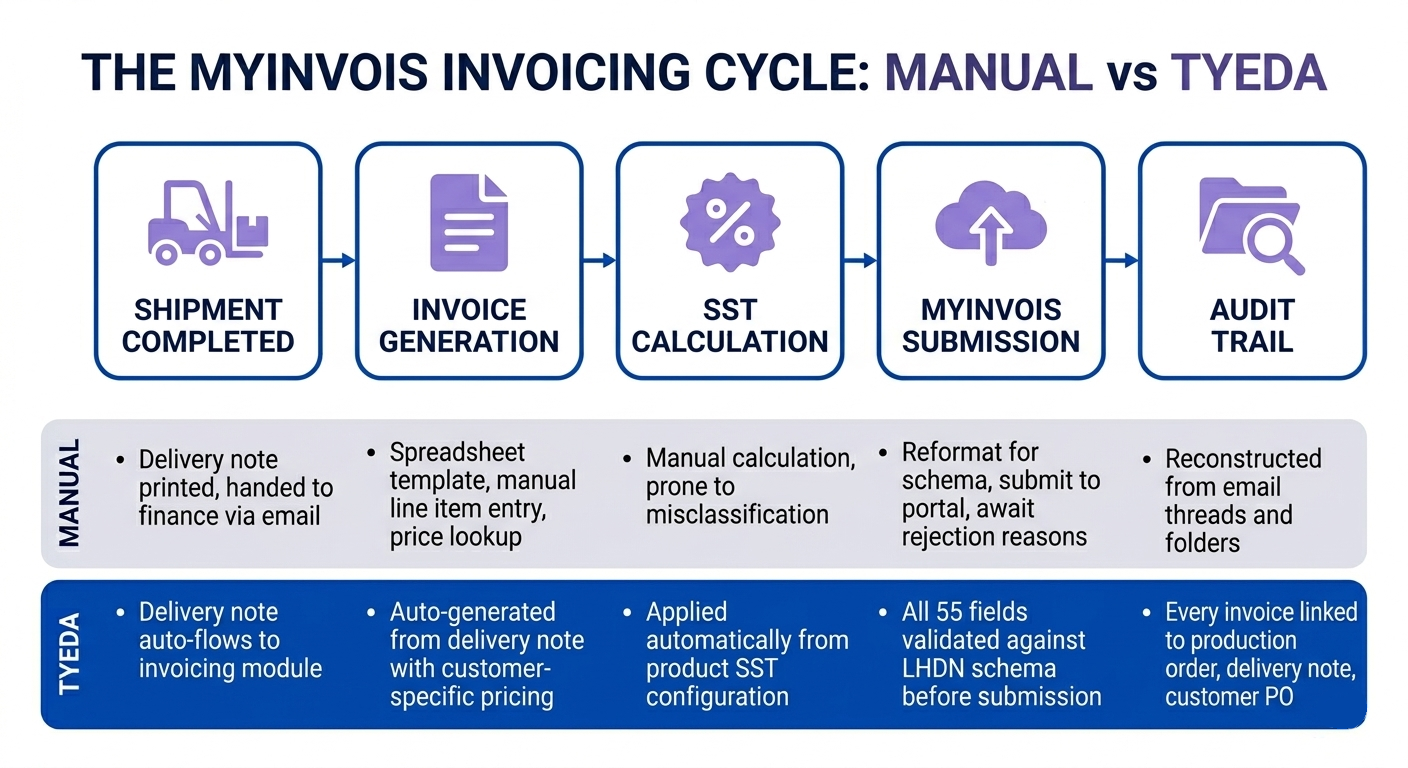
Under the Inland Revenue Board of Malaysia's phased rollout, every business with annual turnover above RM1 million must issue and validate e-invoices through the MyInvois system, with each invoice required to contain 55 specific data fields covering seller, buyer, transaction, tax and payment details (LHDN, MyInvois Guideline; ClearTax Malaysia, 2026). The pattern is recognisable in most finance offices: an invoice is built manually in a spreadsheet, exported, transformed to match the MyInvois schema, submitted to LHDN, and resubmitted when the first attempt fails because of a missing buyer TIN or an incorrect SST classification.
The reason this happens is **structural. Invoicing in most SME manufacturers is not a connected function. It is a copy-and-paste function that begins after production and shipping are already complete. A delivery note is generated on the floor, the quantities are copied into a spreadsheet, the prices are looked up from a customer-specific price list, the SST is calculated, and the document is then reformatted to meet the MyInvois schema. Each step introduces an opportunity for error, and the error is only discovered after submission has failed. Replacing manual invoicing with a structured, integrated **LHDN e-invoice compliance system closes this gap, so every invoice is generated from validated production and shipping data, the SST treatment is applied automatically from the product configuration, and the MyInvois submission is validated before it leaves the system.
Phase 4 Has Started, and Penalty Enforcement Begins in 2028
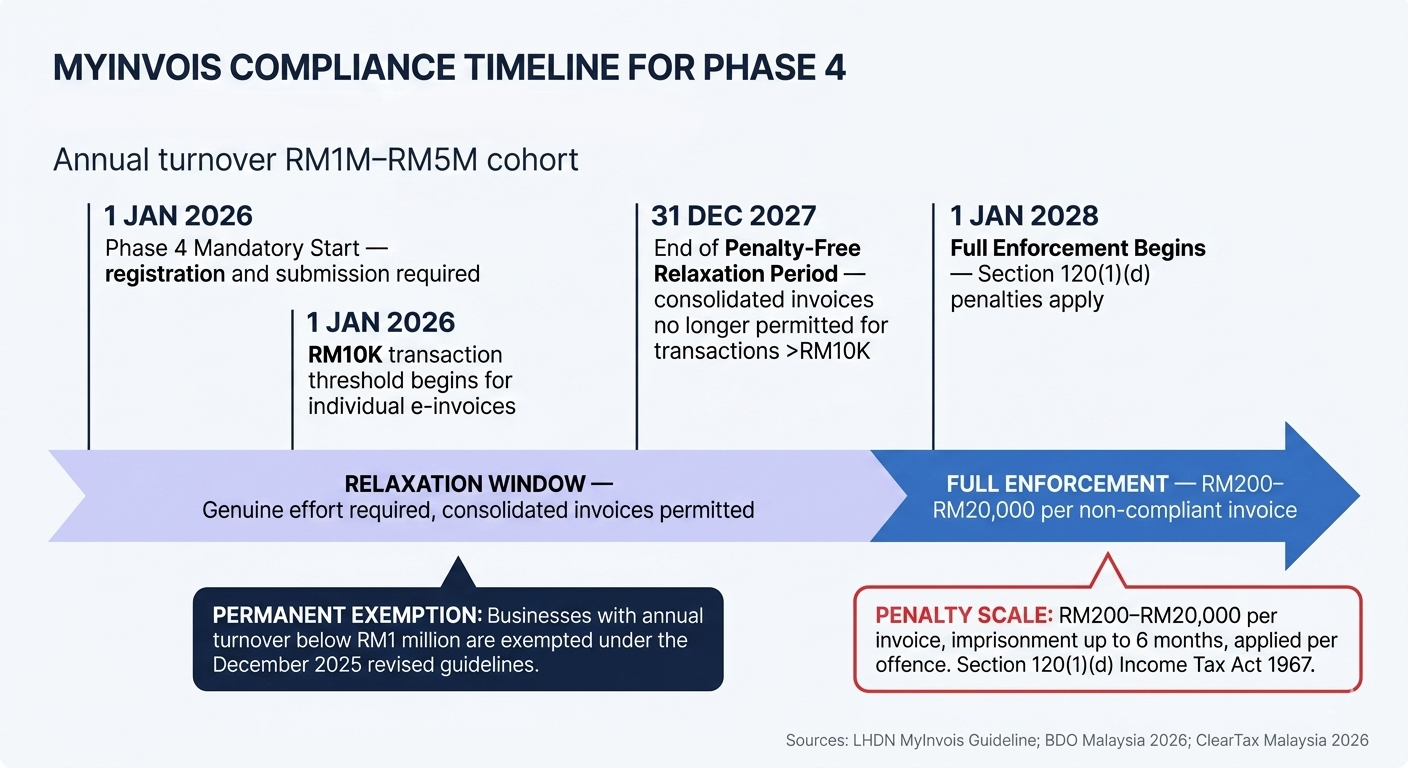
Effective 1 January 2026, MyInvois became mandatory for businesses with annual turnover between RM1 million and RM5 million: the current phase, Phase 4, includes the bulk of Malaysian SME manufacturers. The Inland Revenue Board, following announcements by the Prime Minister in early 2026, has extended the penalty-free relaxation period for phase 4 businesses to 31 December 2027, meaning consolidated e-invoices remain permitted during this window. Full enforcement under Section 120(1)(d) of the Income Tax Act 1967 begins 1 January 2028, with penalties of RM200 to RM20,000 per non-compliant invoice or imprisonment of up to six months, applied per offence (BDO Malaysia, 2026; .JomEInvoice, 2026; Malaysia4U, 2026).
Even during the relaxation window, businesses are required to register on MyInvois and demonstrate genuine effort to comply. Effective 1 January 2026, individual e-invoices are mandatory for any transaction above RM10,000, consolidated invoices are no longer permitted for these transactions, and businesses below RM1 million in annual turnover are permanently exempted under the revised guidelines issued in December 2025 (ClearTax Malaysia, 2026; Info-Tech Malaysia, 2026). For Malaysian SME manufacturers, this means the window for relying on spreadsheets and manual submissions is closing in a defined, documented way, and the cost of being unprepared in 2028 is unambiguous.
When Invoicing Is Disconnected from Production, Cash Flow Pays the Price
Even in factories that submit MyInvois invoices on time, the disconnection between production and invoicing carries a quieter cost. An order is shipped on Monday and invoiced on Friday because the finance team is working through a backlog. A partial shipment is invoiced in full because the picking note was missed. A price adjustment agreed with the customer is not reflected because it was communicated verbally and never updated in the price list. Each of these is a small error individually, and collectively they delay payment by days and trigger disputes that take weeks to resolve.
Without a structured invoicing workflow tied to production and shipping data, there is no reliable way to ensure that what was shipped is what was invoiced, that the price applied is the current customer-specific price, and that the invoice is issued the same day the shipment leaves the dock. The shift from disconnected invoicing to integrated invoicing begins when every shipment generates an invoice automatically, the customer's current pricing and SST treatment are applied without manual lookup, and the document is submitted to MyInvois the moment it is approved.
How Tyeda's MyInvois Invoicing and Compliance System Addresses Each of These Gaps
Tyeda's invoicing module ties customer master data, production and shipping records, SST configuration and MyInvois submission into one connected workflow, replacing the chain of spreadsheets, lookups and end-of-day batch submissions that currently sit between a completed shipment and a validated e-invoice.
When a shipment is completed on the floor, the invoice is generated automatically from the delivery note, with line items, quantities and customer-specific pricing populated from the master data. SST is applied based on each product's configured treatment, all 55 MyInvois data fields are populated from the underlying records, and the document is validated against the LHDN schema before it is submitted. Submission status, including the validated QR code and unique identifier, is captured against the invoice and visible from the same screen.
Rejected submissions surface immediately with a clear reason, and the corrected resubmission carries the same audit trail forward. Bimonthly SST aggregation runs automatically from the underlying invoice data, so the return is prepared from the system rather than reconstructed from exports. Every invoice is linked back to the production order, the delivery note and the customer purchase order it relates to, so audit requests and customer queries are answered from the system in minutes rather than from email threads over days.
Existing customer masters, price lists and product SST configurations can be imported via CSV, so your commercial data carries over and the transition does not require rebuilding from scratch. A factory can be live on basic invoice generation and MyInvois submission within the first week of onboarding, with bimonthly SST aggregation and full audit reporting rolling out as your operations require them.
Why Integrated Invoicing Matters More Than Ever for Malaysian Manufacturers
The phased MyInvois rollout has now reached the threshold where most mid-sized Malaysian manufacturers are within mandatory scope, and the December 2027 deadline for the end of the Phase 4 relaxation period is fixed (BDO Malaysia, 2026). At the same time, Malaysia's New Industrial Master Plan 2030 expects mid-sized manufacturers to operate with a level of digital commercial data readiness that begins with structured invoicing (MIDA, 2023). Manufacturers building integrated invoicing and compliance systems now will be operating with cash flow and audit certainty that their spreadsheet-bound peers cannot match.
Tyeda is a manufacturing operations platform built for Malaysian mid-sized manufacturers, bringing production, procurement, quality, maintenance and compliance into one unified real-time system that meets MyInvois requirements and protects cash flow. We are currently onboarding a limited number of manufacturers ahead of our full platform launch. Join the waiting list at landing.tyeda-technologies.com.
For more on how connected production data supports invoicing outcomes, read: Production Order Management for Malaysian Manufacturers: A Field Guide for SME Factories.