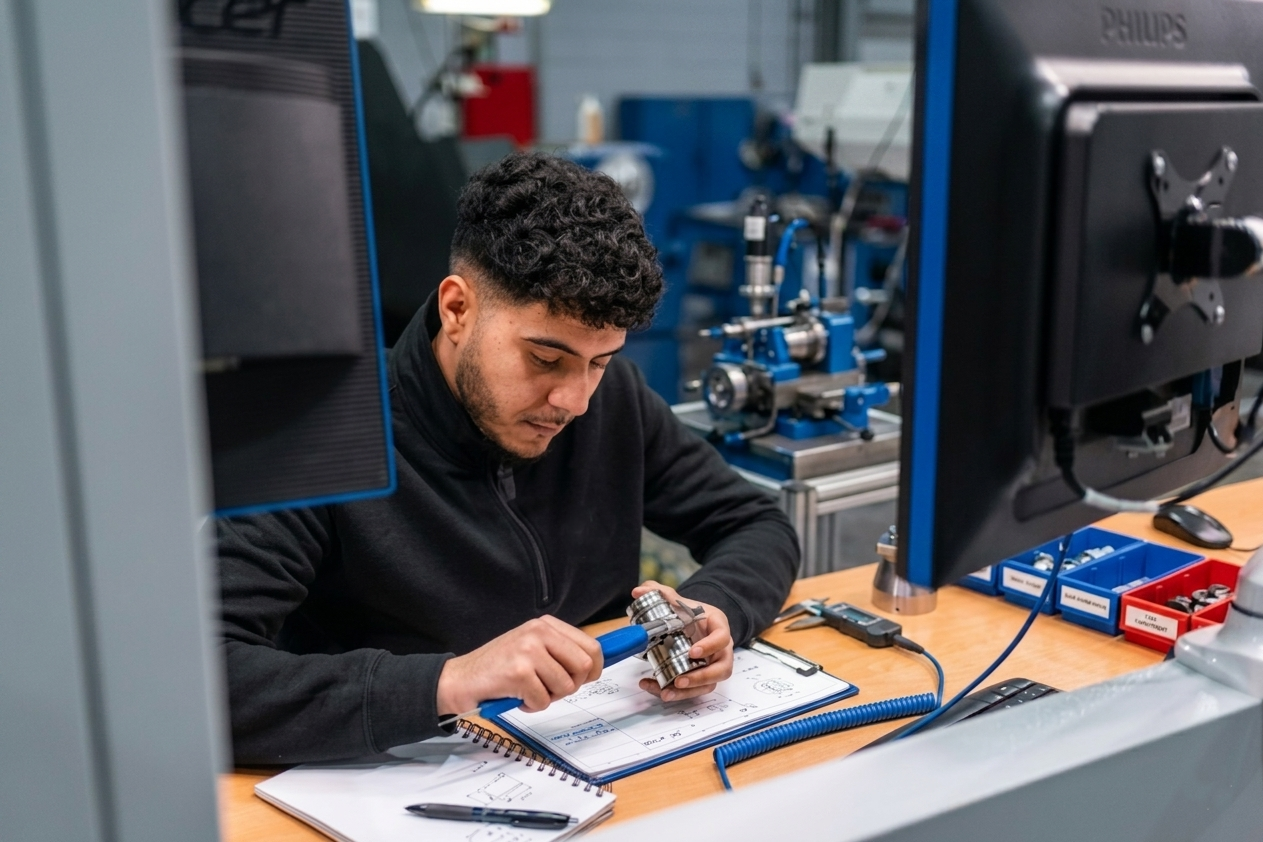
Malaysian mid-sized manufacturers are absorbing the cost of quality issues that should have been caught long before the shipment left the dock. Especially if they are running inspections on paper checklists, logging defects in standalone notebooks at each station, and discovering pattern problems only when a customer raises a formal complaint. It may not register as a process failure when the rework rate is steady, but it imposes a recurring tax on margin and a slow erosion of customer confidence that compounds with every shipment. A structured quality management system for manufacturing solves this by binding every inspection to a specific production order, capturing non-conformance data in real time, and turning what was once paperwork into a live record of how the factory is actually performing. This article explains why the visibility gap exists, how Tyeda's Quality Management module is built to close it, and why it matters now.
Why Paper-Based Inspections Let Defects Travel Through the Factory
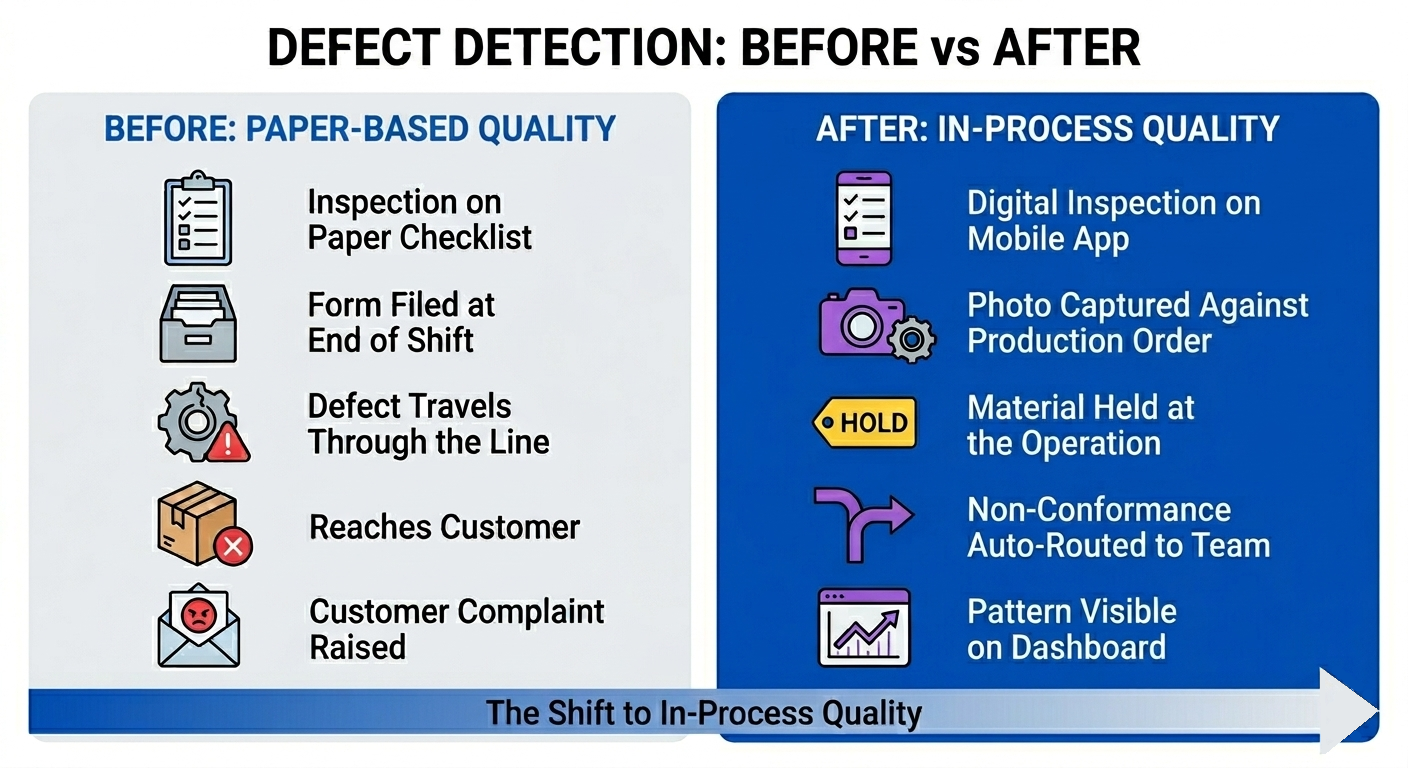
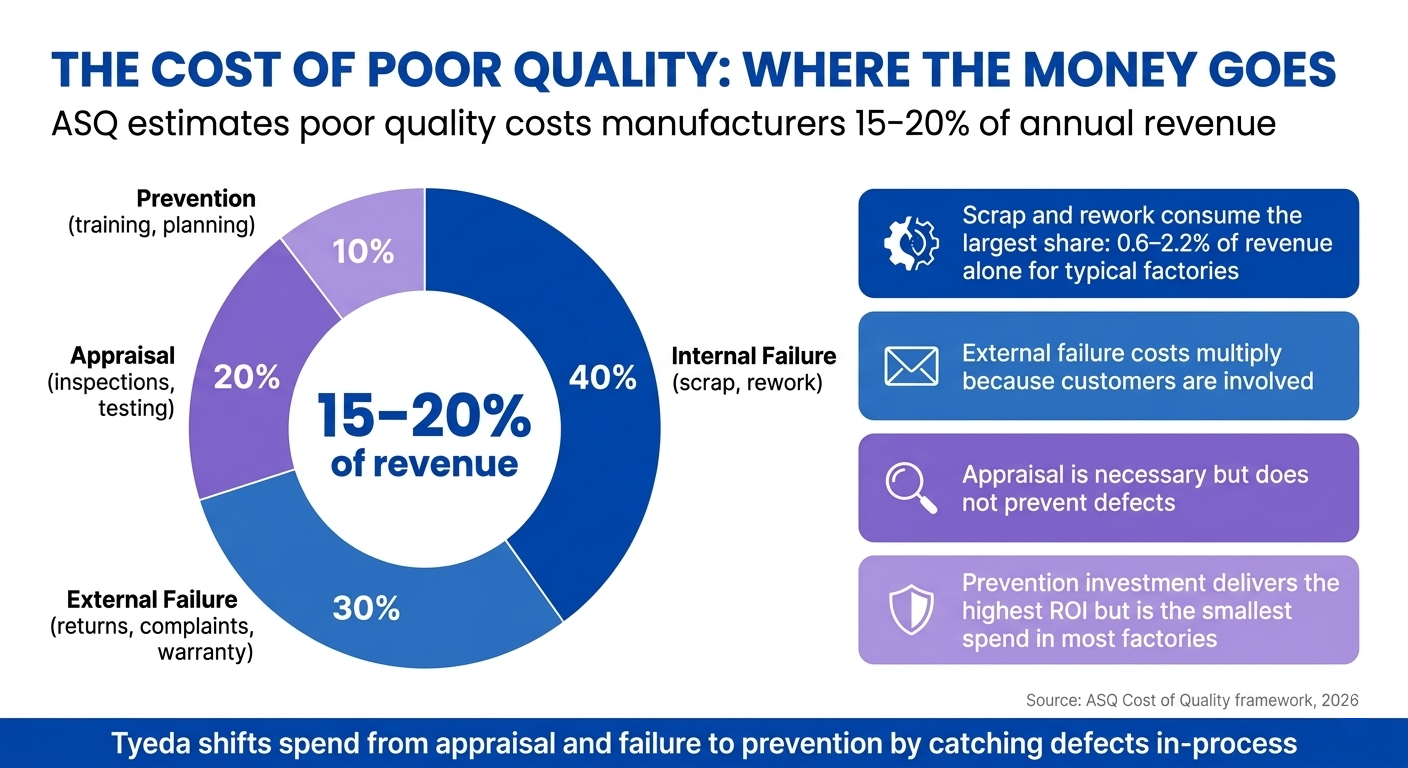
The American Society for Quality estimates that the cost of poor quality, including scrap and rework, can consume 15% to 20% of annual sales for many manufacturers, with the bulk of that cost traced to defects discovered after the value-add work has been performed rather than at the operation that introduced them (ASQ, as reported by EASE and QT9, 2026). The pattern is consistent in most SME factories: an in-process quality inspection is performed at a workstation, a tick appears on a paper form, the form is filed at the end of the shift, and no one in production planning or engineering sees the result until a problem becomes too big to ignore.
The reason this happens is **structural**. Quality inspection in manufacturing is not an end-of-line activity. It is a series of decisions made at each operation about whether to pass material forward, and each decision generates information that is valuable only if the rest of the factory can see it. When inspection records live on paper, that information is invisible until someone reconstructs it for an audit or a customer complaint. Replacing paper checklists with a structured in-process quality system closes this gap, so every inspection result is captured against the production order, the operation and the operator at the moment it is performed, and patterns surface on a dashboard rather than in a customer email.
When Non-Conformance Data Lives in Notebooks, Root Causes Stay Hidden
Even in factories that take quality seriously, the non-conformance report is often the weakest part of the system. Defects are noted in shift logbooks, described in WhatsApp messages between supervisors, and summarised verbally at the morning meeting. The same defect mode recurs across weeks and goes unrecognised because no one is looking at the data in aggregate. When a customer eventually raises a corrective action request, the response is reconstructed from memory and partial records.
Industry benchmarks indicate that scrap and rework costs alone typically range from 0.6% of revenue for top performers to 2.2% for bottom performers, a gap that traces almost entirely to whether defects are captured systematically at the point of detection or reconstructed later from informal notes (EASE, 2026). Without a structured non-conformance reporting workflow, there is no objective basis for prioritising corrective action, no clear view of which products, suppliers or operations are generating the most rework, and no traceable record when a regulated customer asks for one. The shift from notebook-based defect logging to structured non-conformance management begins when every defect is categorised, attached to its production order, photographed where relevant, and routed to the responsible team automatically, so the data needed to improve is generated as a byproduct of running quality rather than as a separate reporting task.
Without a Link Between Quality and Production, Improvement Stalls
The third gap is the one that quietly limits factory performance over time. Quality records and production records exist in separate systems, or in separate files within the same system, and the relationship between them is reconstructed manually whenever someone needs to ask a question. Which work centre is generating the most defects this quarter. Which raw material lot correlates with a spike in rework. Which routing has consistently lower first-pass yield than its standard. These questions are answerable in principle and unanswered in practice.
The deeper consequence is that quality becomes a reactive function. The team responds to complaints and audits rather than steering performance day to day. McKinsey research summarised in 2024 indicates that manufacturers adopting digital validation and feedback loops can reduce defect-related costs by up to 30% compared with operations running disconnected quality and production systems (McKinsey, as reported by PicoMES, 2026). A connected quality system closes this by treating every inspection, every non-conformance and every customer complaint as a record attached to the production order that generated it, so first-pass yield, defect rate by work centre, and supplier-related quality issues are visible the moment the data is captured.
How Tyeda's Quality Management System for Manufacturing Addresses Each of These Gaps
Tyeda's quality module ties in-process inspections, non-conformance records and customer complaints into one connected workflow, replacing the chain of paper checklists, shift logbooks and reconstructed audit responses that currently sit between a defect being detected and a corrective action being closed.
Inspection checklists are configured per product or per operation and presented to operators on the mobile app at the point of inspection. Pass-fail results, measurements and photos are captured against the production order in real time, and the result determines whether material is released forward or held. There is no separate quality form, no end-of-shift transcription, and no gap between when a defect is detected and when production planning sees it.
When a non-conformance is raised, it is categorised, attached to the production order and the operation that generated it, and routed to the responsible team for disposition. Customer complaints are logged against the original shipment, traced back to the production order, and linked to any non-conformance records that share the same root cause. Over time, every transaction builds your quality intelligence without any extra work: first-pass yield, defect rate by work centre and supplier-related quality issues are calculated automatically from the data your team is already recording.
Existing inspection templates and defect categories can be imported via CSV, so your standards carry over and the transition does not require rebuilding your quality plan from scratch. A factory can be live on basic in-process inspections and non-conformance reporting within the first two weeks of onboarding, with customer complaint tracking and supplier quality analytics rolling out as your operations require them.
Why Structured Quality Management Matters More Than Ever for Malaysian Manufacturers
Customer expectations across automotive, electronics and food manufacturing are tightening, with multinational buyers increasingly making structured quality data and traceability a condition of supply rather than a differentiator. At the same time, the New Industrial Master Plan 2030 expects mid-sized Malaysian manufacturers to operate at a level of data readiness that begins with structured quality records on the factory floor (MIDA, 2023; MITI, 2025). Manufacturers building connected quality control software now will be qualifying for contracts that their less-instrumented peers will not.
Tyeda is a manufacturing operations platform built for Malaysian mid-sized manufacturers, bringing production, procurement, quality and compliance into one unified real-time system that catches defects in-process and protects customer relationships. We are currently onboarding a limited number of manufacturers ahead of our full platform launch. Join the waiting list at landing.tyeda-technologies.com.
For more on how connected production data supports quality outcomes, read: Production Order Management in Malaysia: Why SME Factories Need a Connected BOM and Job System.